Sonic Threads: (re)interpreting territories and weaving interconnectedness through listening spaces for reciprocity
Abstract
The purpose of Sonic Threads is to explore the possibility of (re)interpreting territories and our personal and collective affections towards them, taking into consideration their interconnected nature and ecological importance. Thinking of sonic information as threads can highlight the possibility of weaving small stories into bigger ones. Doing this can also reveal the interdependencies that exist within a given territory as well as on a global scale, offering a chance to ponder on the notion of reciprocity: in human relationships and with the environment. This “fabric” of sounds can also expose entanglements that allow thresholds of abstraction in between meaning and perceptual experience. A sonic narrative may be achieved by combining listening processes and field recordings of ecosystems as starting points. The sonic threads can then be displayed together as a conglomerate soundscape composed of dialogues, testimonies, voices, field recordings. This artistic research project will attempt to foster spaces for listening practices that can allow both individuals and collectives to echo and recognise ecologies of memories, affective relationships and identities. In addition, focusing on their intrinsic connection to the environments that birthed them and the ones they have a sense of belonging with presents an opportunity to dig deeper into sonic correspondences - both inside the soundscape and as an ongoing reflection-, as well as sonic interpellations in between places, as an act of awareness of the geopolitics that connect them: sounds of labour? Pleasure? Extraction? Delicacy? Local food? Pollution? Deforestation? Starting from my personal sense of belonging, my ecological identity and memories, as well as my listening and recording practices, I intend to discover how to find commonalities through the crafting of intertwining poetics of listening and the significance of bringing such matters to a European context.
Keywords: soundscape, listening ecologies, territory, acoustemology
Introduction
How does fabric work?
In a general sense, it is formed by interlacing threads, either on a loom or by knitting. Although it has particular orders and methods for how the threads need to be woven, its original interlaced elements -threads made out of threads-, evoke memory, interconnection and interdependence.
When we talk about listening and territory, this interdependence may not occur along pre-designed patterns. It can rather be chaotic yet meaningful. Sound can be heard, listened, imagined, remembered, described, recorded, mediated. Listening thus becomes a crucial part of how we connect with our surroundings and the places we interact with. Exploring the idea of sound as a poetic concept, as Séan Street proposes in Sound Poetics (Street, S., 2017), by listening we create memories, imaginaries, and also the possibility of forming our ecological identity which Michel Thomashow defines as how people construe themselves in relation to the planet, with a unique blend of intuitive, cognitive and affective perceptions of ecological relationships (Thomashow, M., 1995).
Discerning these interrelations within an ecosystem with reciprocity traditions is something I have been exposed to since childhood. How can I evidence-through-sound this relationship with the territory without positioning Andean/Indigenous knowledge as a resource for European spiritual and intellectual renewal? What does it mean to bring such matters to a listening space in a European context?
In an attempt to steer away from highlighting differences as if they were essential, I would rather like to emphasise ayni as a complex relationship with the land that is rooted in reciprocity. Generally understood as a social and labor-based system of mutual obligation between community members and between humans and non-human entities - therefore it has an important economic dimension to it -; at the same time it is not merely a practice of exchange: it is the generative field from which (human and non-human) beings themselves come into existence. It can be convoluted, ambiguous and contradictory at times and it is related to ways of living that are specific to this particular territory. These reciprocal relations frequently do not imply symmetry as they are navigated in a field of power: an asymmetrical yet continuing to be productive situation of “collaborative survival” (Tsing, 2015). I learned about it in Puno, my hometown, located on the high plateau of the Andes, in the South East of Peru, on the shores of Lake Titicaca, close to the border with Bolivia.
In Puno, the notion of territory is paramount and it is expressed sonically: through strong oral and music traditions; in protest chants from an ongoing condition of resistance but also as identity and partnership with nature; in indigenous languages and epistemologies; in synchretic rituals; also in ways of listening to the environment that I still haven’t been able to fully grasp or theorise. I believe that my experience of this acoustic environment may have amplified my aural sense and forged a strong sonic bond with the region I am from: the particular reverberance of the high plateau of the Andes that harbours lake Titicaca’s basin that embraces its unique ecosystem sounds: fauna thriving from the wetlands to the surroundings summits, winds, heavy rain, thunders resonating from kilometers away, the calmness and vastness of the lake, and the collective chanting, flutes and bass drums on the beat of two very distinct seasons that dictate agriculture, farming and water harvesting cycles.
It was not until I collaborated on a previous artistic project with Marvila Quispe, a farmer from Caritamaya, an Aymara community 30km south of Puno, that I started understanding more about the Altiplano and acknowledging more about the interconnections of relying heavily on it on a daily basis, while also being a bioregion (McGinnis, 1999) common to us both. As Steven Feld emphasised with acoustemology, to investigate the primacy of sound as a mode of knowledge and existence in the world (Feld, S., 2013), listening in the Altiplano is crucial to recognise the territory and place oneself in it. I reflected on the fact that while both she and I had been brought up in the same place and we shared some commonalities in our sonic relation with the land, I could not overlook the discrepancies in our upbringings and experiences. This process allowed me to acknowledge historical relations of collaborative survival and gave birth to the idea of weaving sonic threads by listening to her stories and how they connect to mine while imagining a common present -and future- rooted in reciprocity. Could this be done in other contexts through a radically receptive listening experience?
These subjectivities continue to transform when migration occurs. In Aotearoa I learned from Tuhoe colleagues the traditional oral art of pepeha. Tuhoe artist Tāme Iti invited us to recite our version of it, after we carried out a reconnaissance of the territory: to introduce ourselves acknowledging our ancestors and the mountains and bodies of water we are connected to. His request resonated with me: Azoguini (a guardian mountain in Puno) and Cancharani, two of the four hills that surround my hometown, and of course, the omnipresent lake Titicaca. Although pepeha is a lot deeper and unique to māori identities and culture, this oral and aural experience allowed new possibilities of threads to interweave and correspond. Could this initial acknowledgement be the foundation for placing ourselves orally into territories?
With this introspective sonic baggage I am presently placing myself in Lisbon, along with colleagues and friends. Every one of us has a particular aural connection to the city and territory, influenced by experiences and unique cultural identities. I intend to explore how to grasp through collective listening and poetics of listening the interconnections of our territories and sonic correspondences between us.

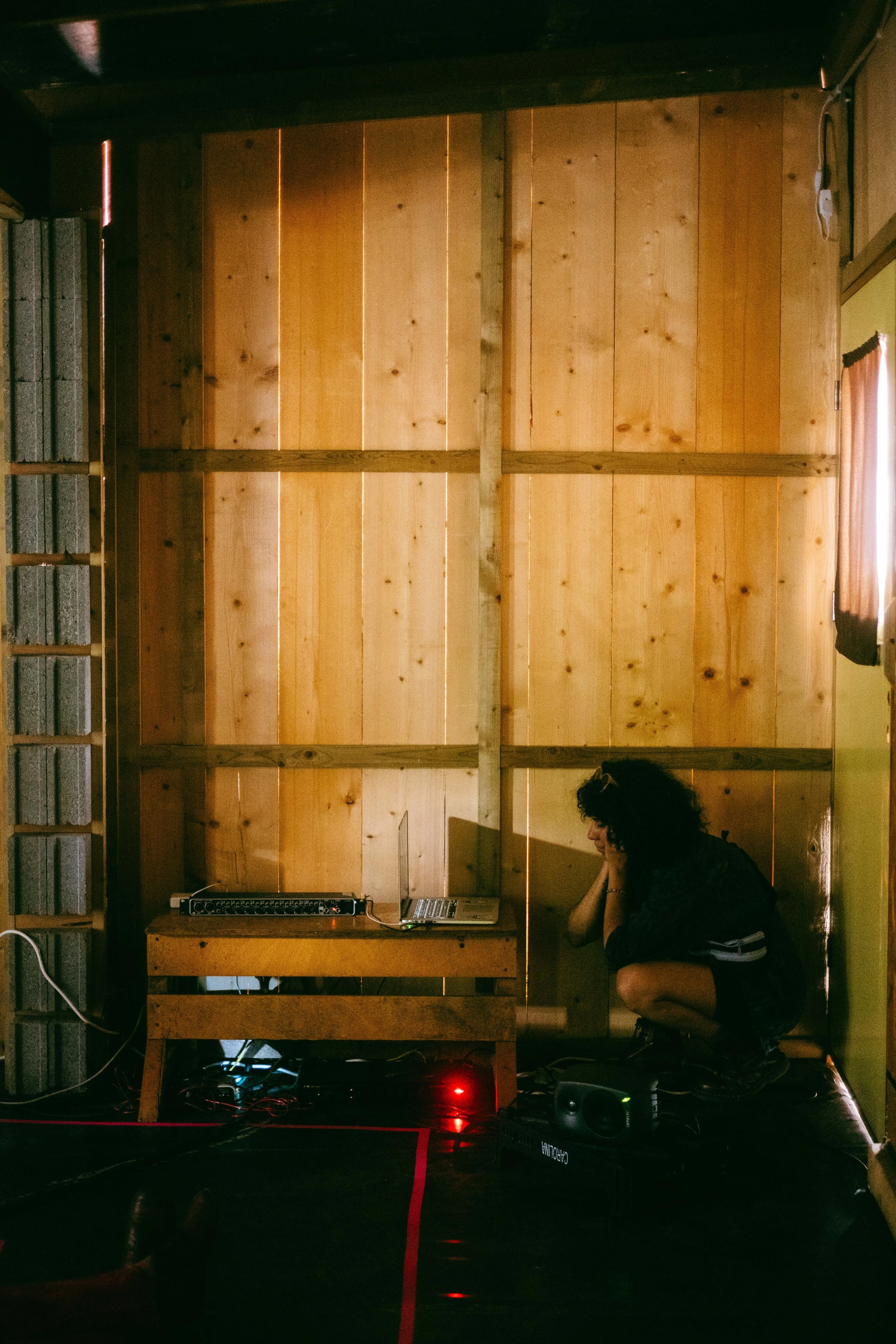
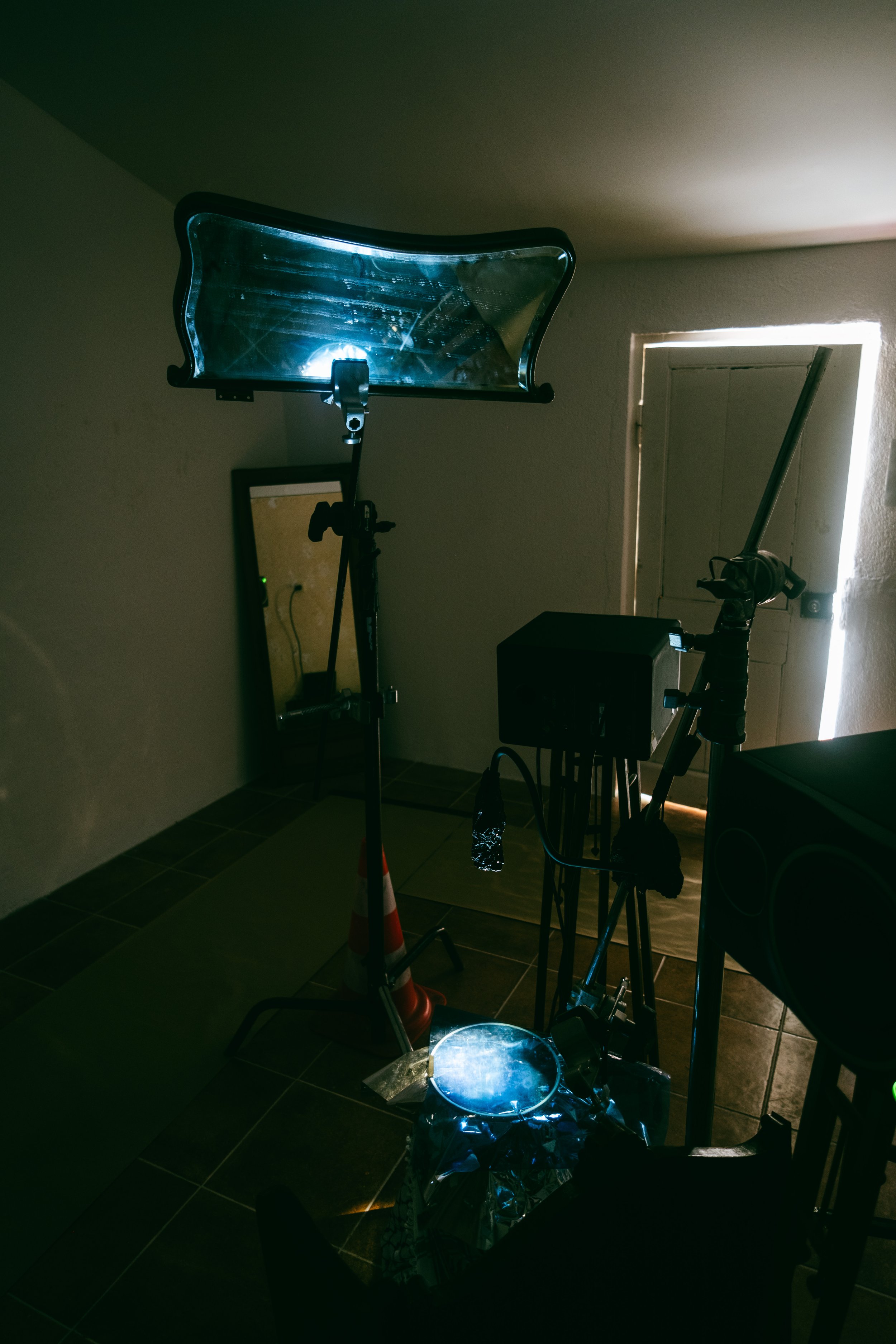
Photos by Vera Marmelo
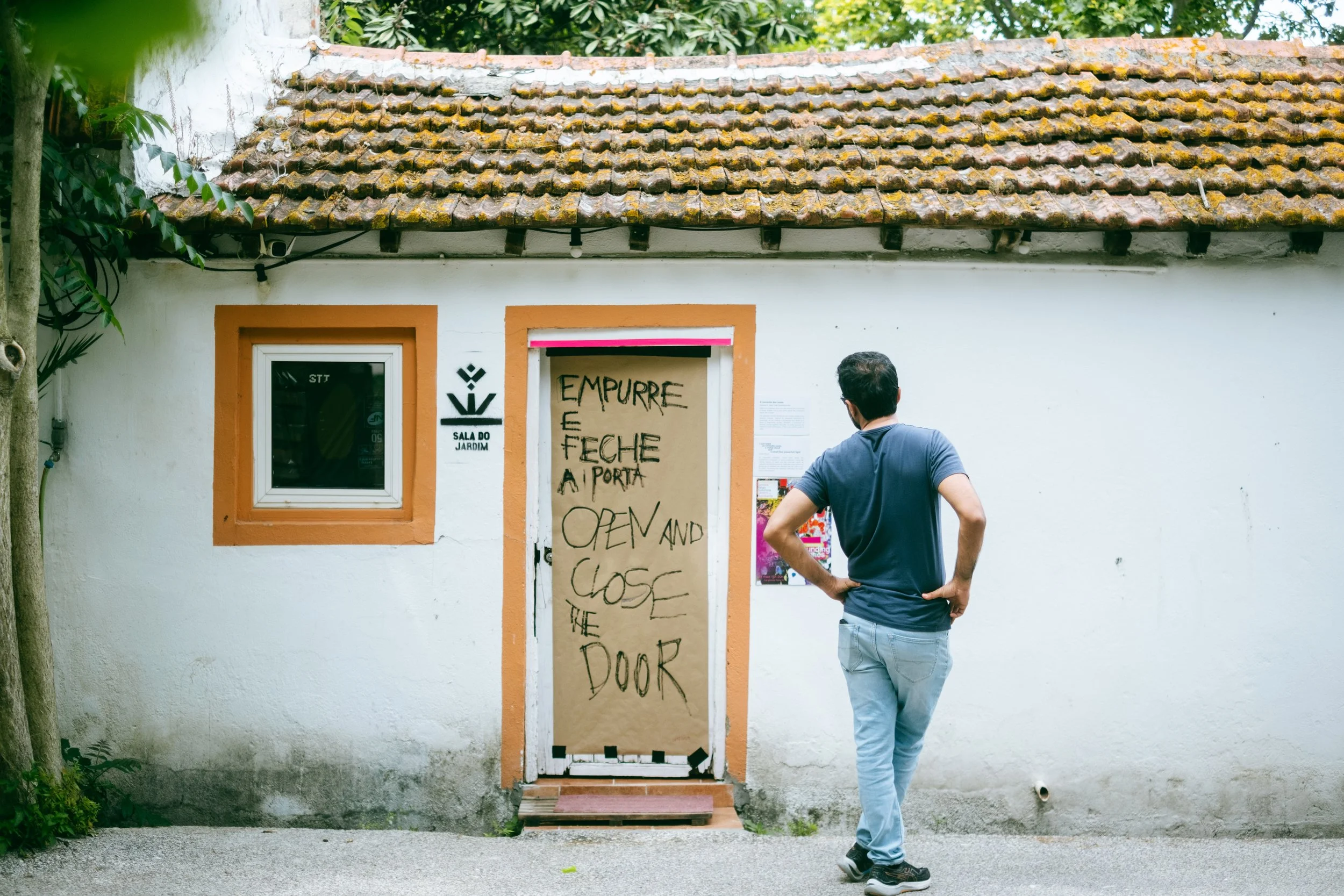
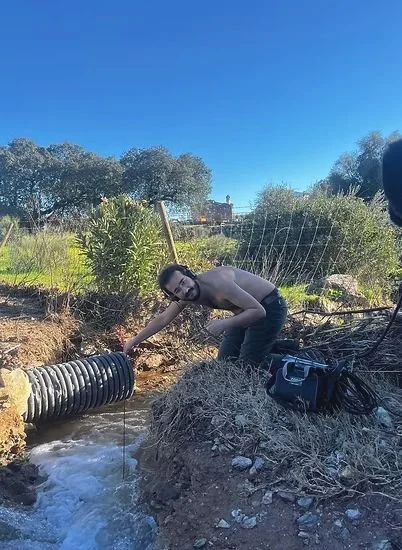
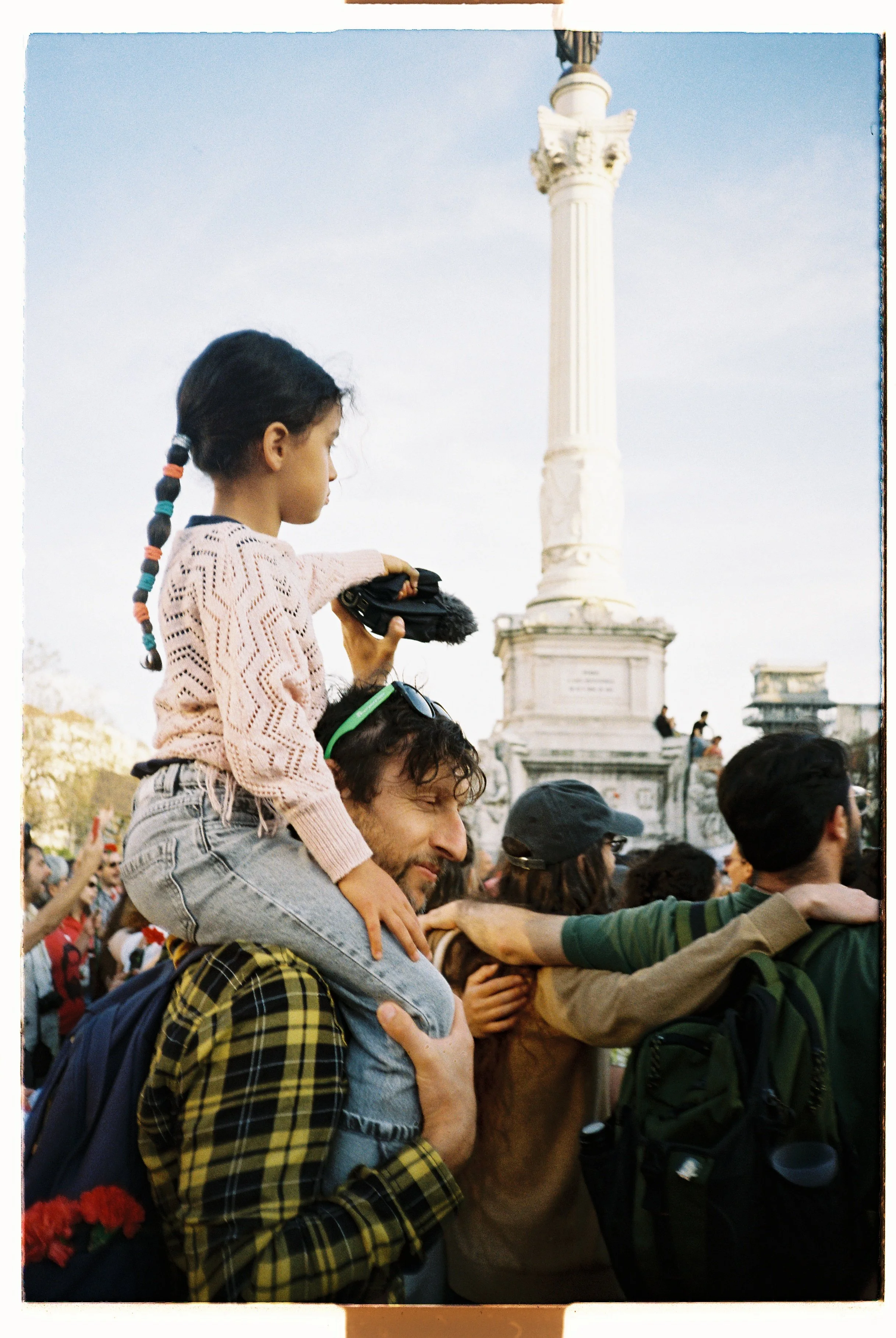
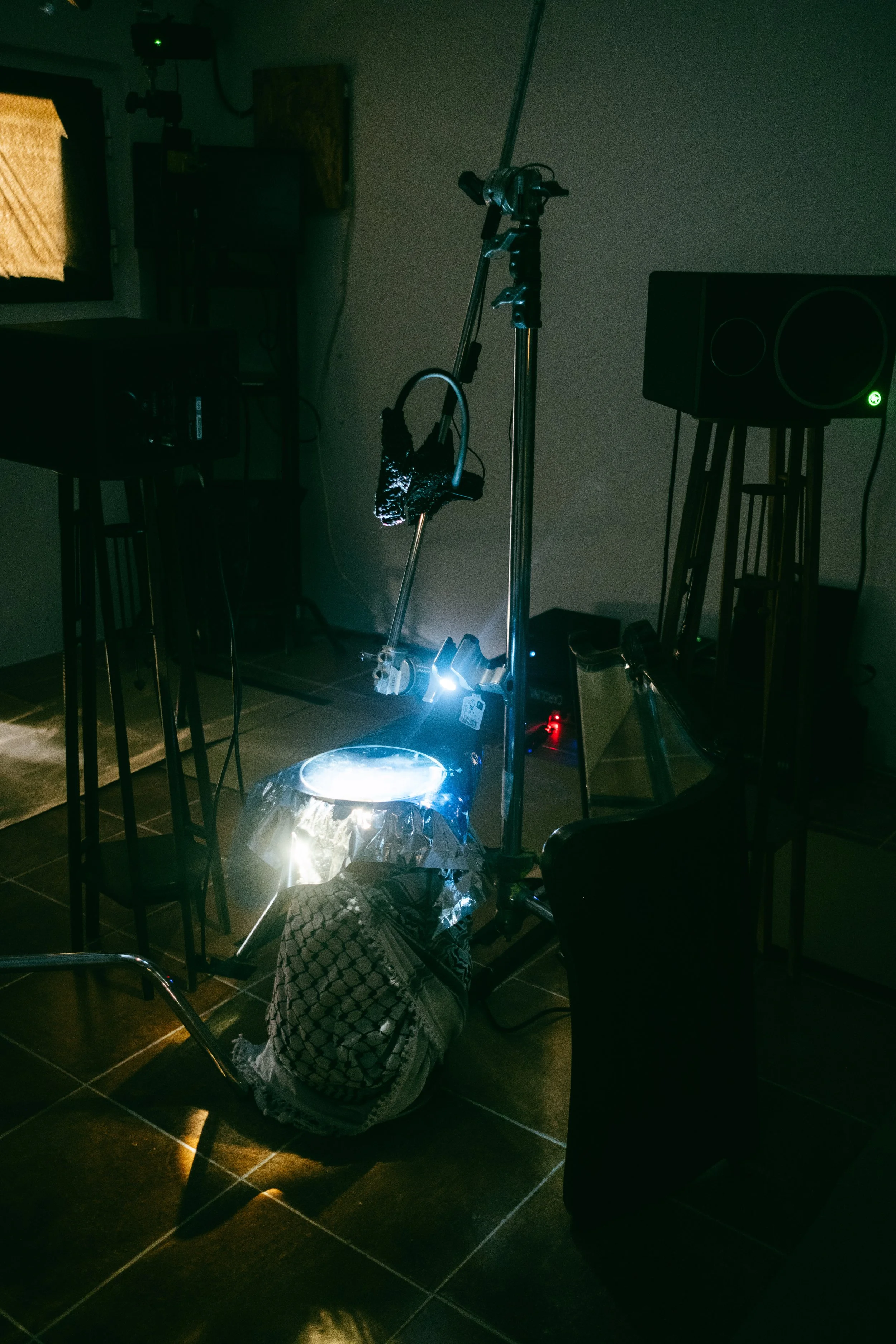
AYNI
AYNI is a ritual-based sound installation that brings together field recordings made between 2021 and 2026 in Peru, Brazil, Colombia, France, Ireland and Portugal. An immersive sonic composition designed for a collective listening environment made as part of the artistic research assignment for Resounding Territories - Sound Ecosystems Project, as well as an ongoing research work on the relations between territory and communities through memory, music and aurality, and how these face the environmental crisis and challenge current political manoeuvres that impact them directly.
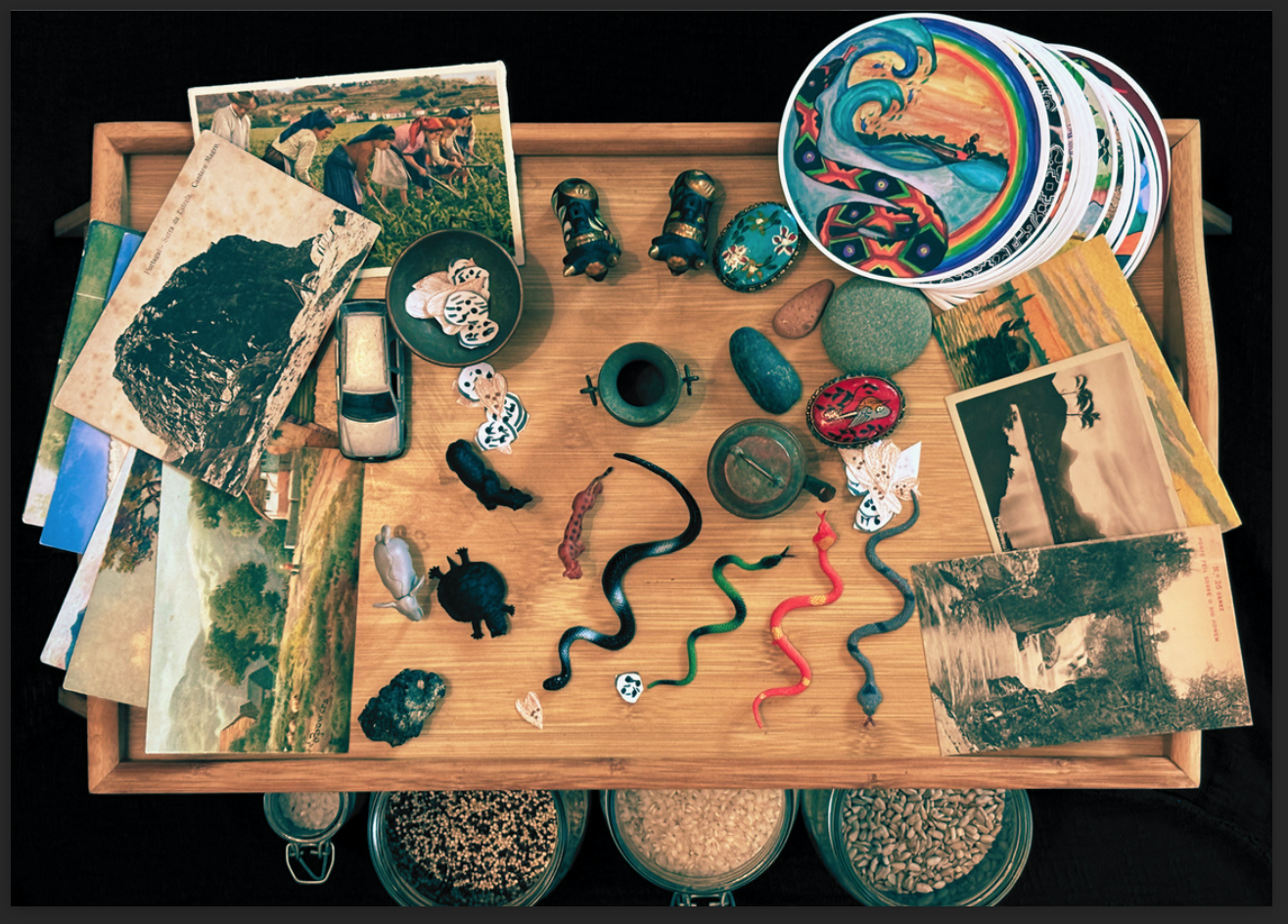
The work is inspired by the Andean concept of Ayni: a convoluted relationship with the land that is rooted in reciprocity. Although it has an important economic dimension to it, it is not merely a practice of exchange but rather the generative field in which (human and non human) beings themselves come into existence. This reciprocal relation does not imply symmetry as it is navigated in a field of power. The installation is focused on the ritualistic side of it, while strongly and respectfully considering all other aspects to it through (an interpretation of) the mesa: the central element of the space which is a set of offerings used in the ceremony of pago a la tierra (payment to earth), the Andean ritual of reciprocity and gratitude to earth.
The purpose of AYNI is to explore the possibility of (re)interpreting territories and our personal and collective affections towards them, taking into consideration their interconnected nature and ecological importance. It also intends to discover how to find commonalities through the crafting of intertwining poetics of listening and the significance of bringing such matters to a European context, which is why the bases of the composition are my personal listening memories of belonging and how these can resonate in others. These objectives motivated proposing the sonic information as threads, because it highlights the possibility of weaving small stories into bigger ones. Doing this can also reveal the interdependencies that exist within a given territory as well as on a global scale, offering a chance to ponder on the notion of reciprocity: in human relationships and with the environment.

A corrente das vozes
Water as a collective (river, rain, sea, stream) has a voice that is always audible. It is a voice which sounds like a thousand voices, like a crowd.
Elias Canetti, Crowds and Power
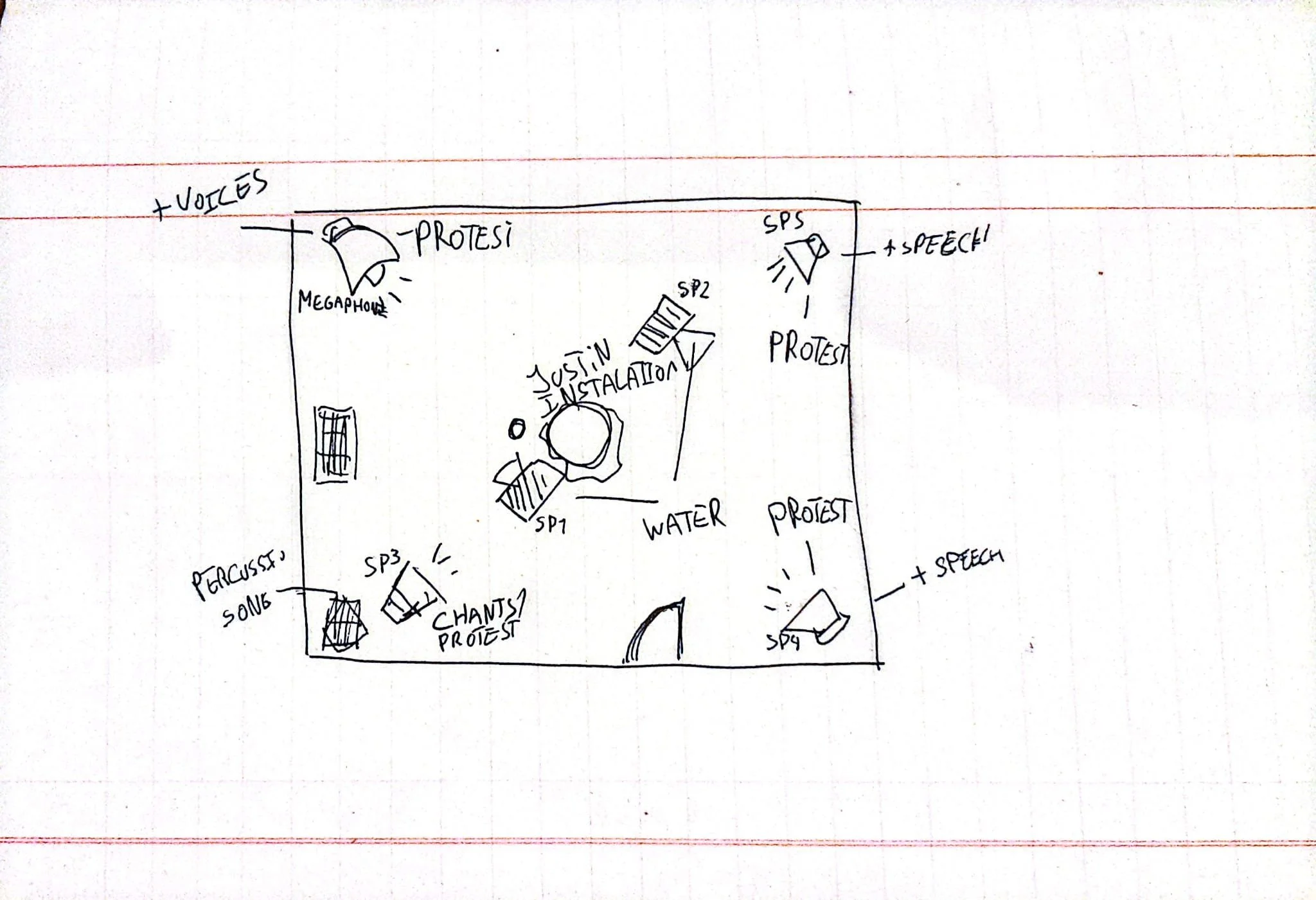
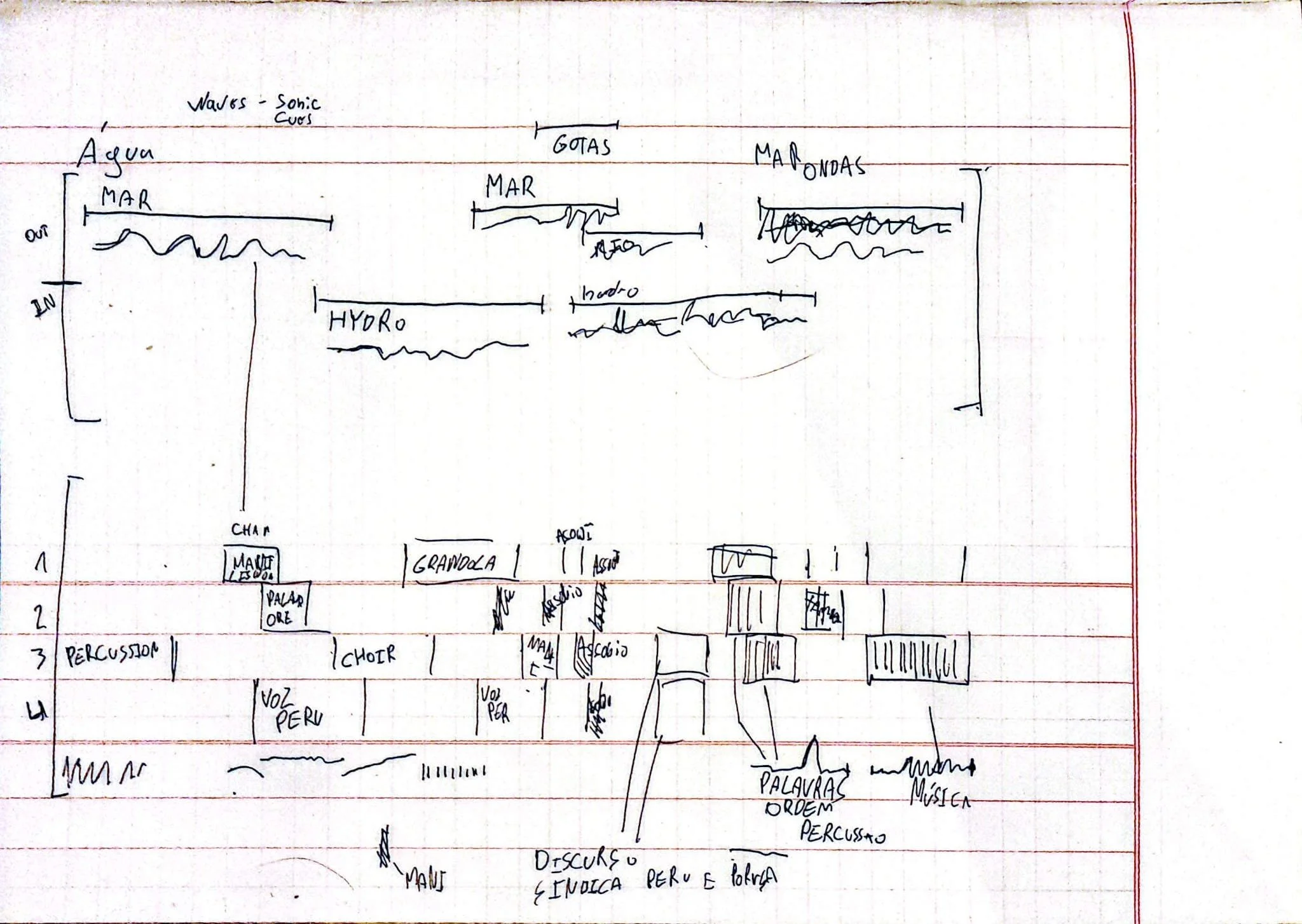
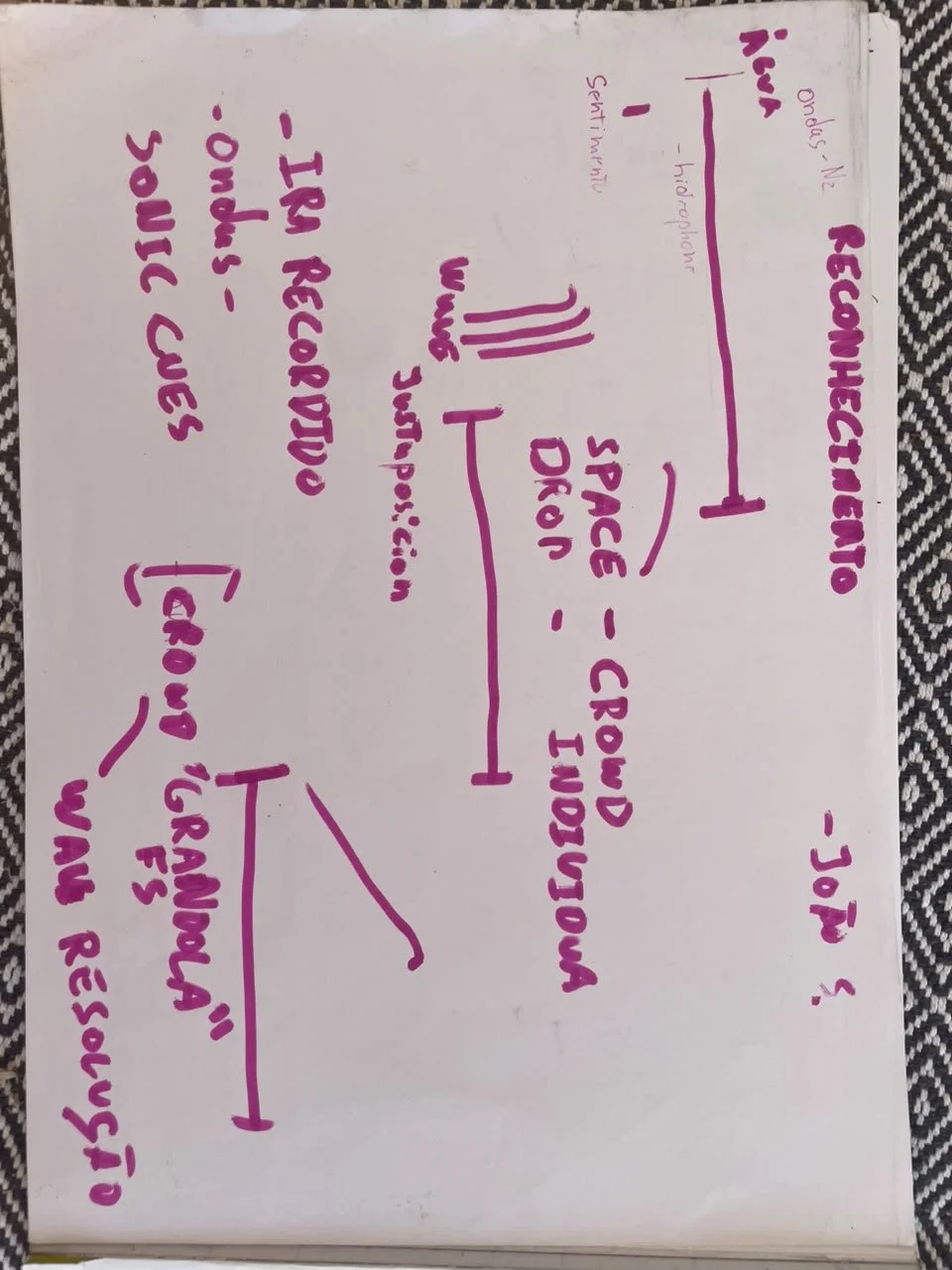
The collective and the territory are the common points of this collaborative research project with João Sarantopoulos. A corrente das vozes is inspired by Foucault’s framework of heterotopy. With joining together our common practice in field recording and interests such as territory and sociopolitical contexts, we created a spatial sound installation as a place of imagination, escape, otherness, and a microcosm of diversity coming together. It consists of a multichannel soundscape composition, placed spatially within an indoors space with other props that symbolise collective resistance, that explores the collective nature of the power of crowds and water: the interaction between different water perspectives as a central foundation, and protests from Peru and Portugal, in an attempt to create a unified powerful voice. The way the sea is connected as a collective voice comes from Canetti’s reflections of how the dense coherence of seawaves shares commonalities with a crowd as a unified voice (Canetti, 1960).
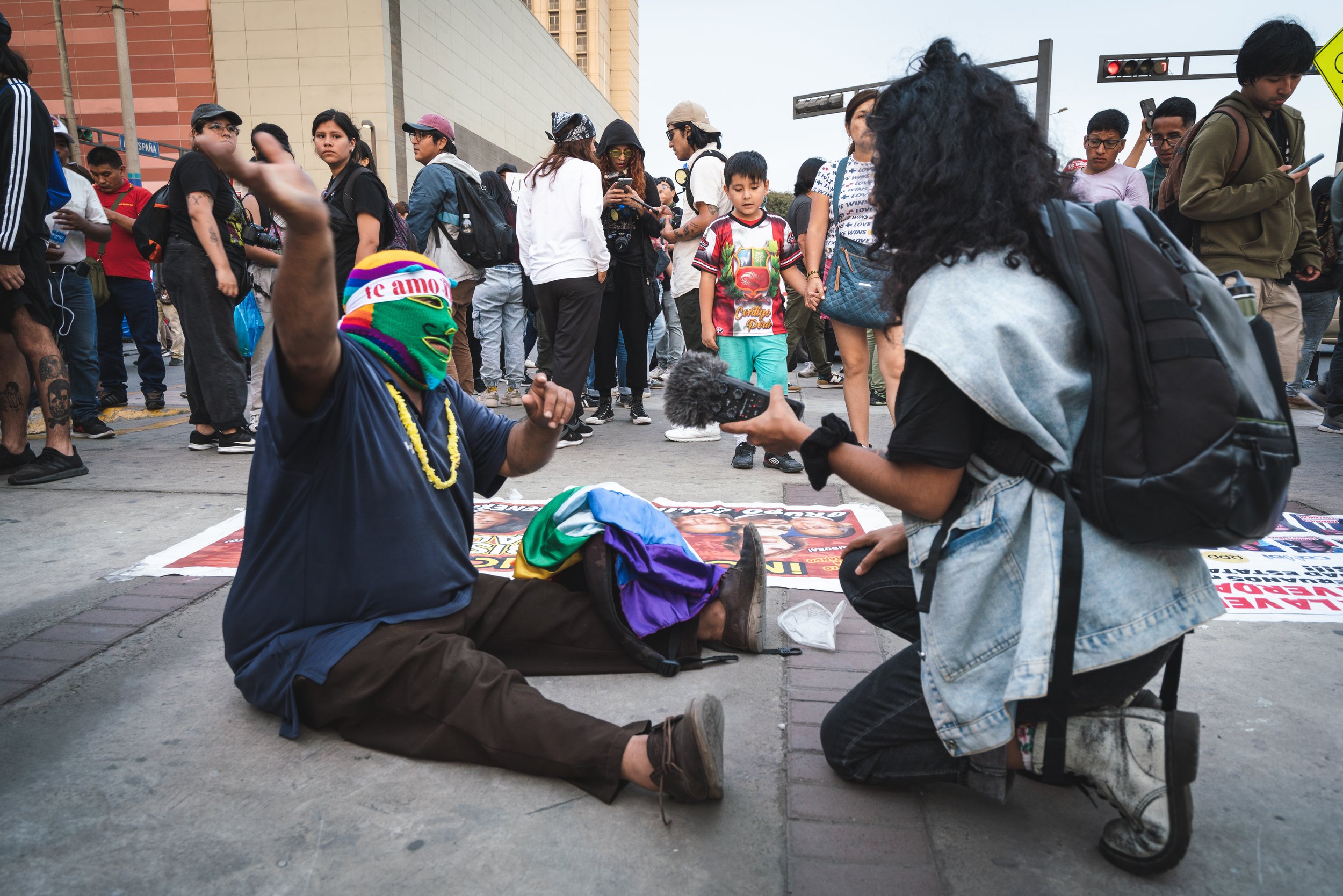
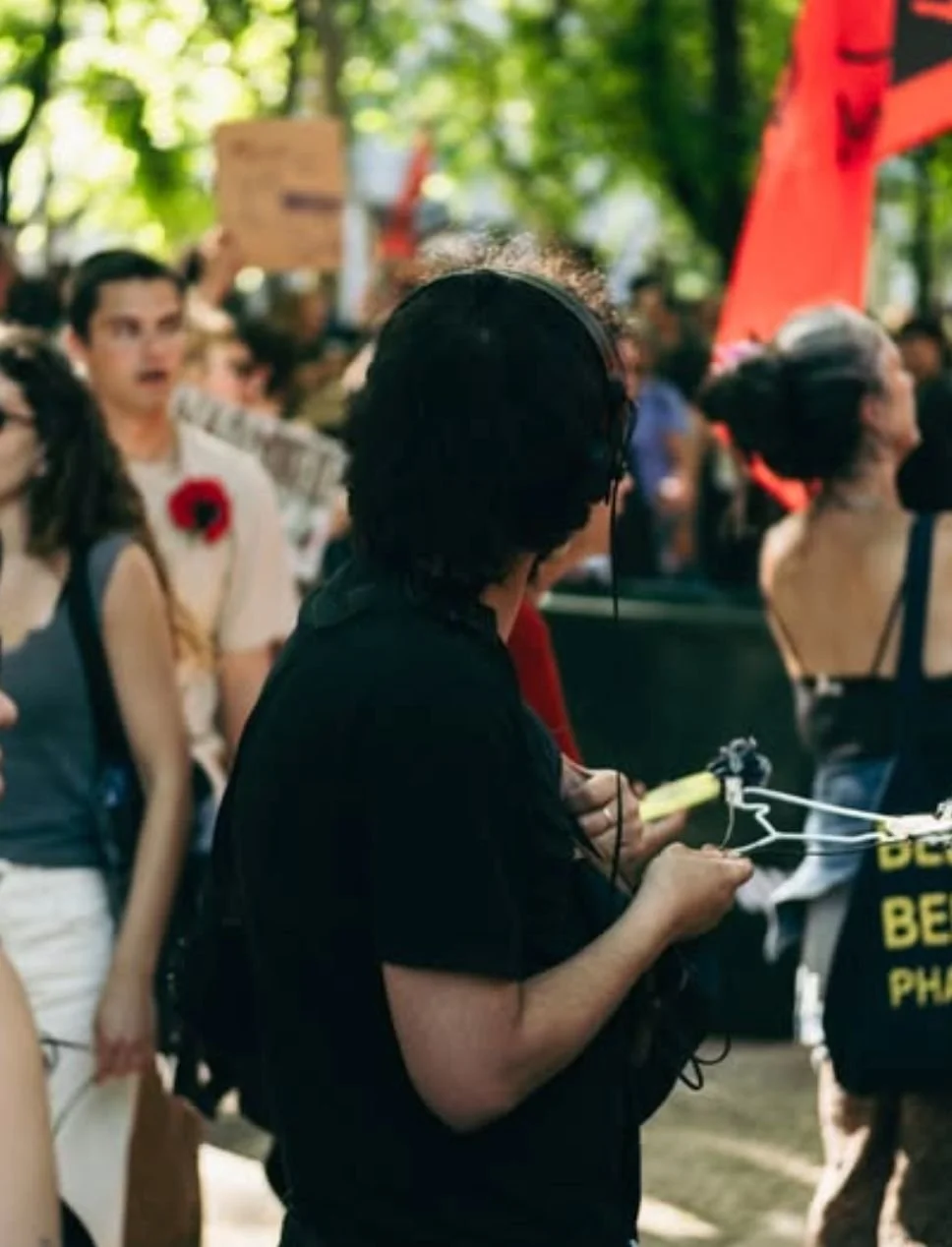
The composition involves recordings from both of us of protests in Lisbon and Peru, as well as recordings of rivers, the ocean, and other underwater environments in Portugal, Ireland, New Zealand and Peru. The objective of the piece is to create a dialogue between different sections of both water and crowds, while navigating through emotions such as rage, hope, resistance with a common comprehensive language that corresponds to all of them.
The sounds are distributed across 6 speakers throughout the space, allowing the audience to move around the installation and notice the sections as individuals but also as a common collective action, both from the water as an omnipresent territory with no borders and a constant powerful voice, and the crowds scattered around. Through the composition, there are times in which the sound of water is the dominant one; and at other times, the sounds of chanting, whistles and percussions resonate in the space allowing the possibility of imagining natural forces as social movements, or the other way around. As the sound moves throughout in layers from surface to depth, from exterior to interior, from one voice to a collective message, it also reflects on memory, persistence, resistance, territory, belonging and the collective nature of (human and non-human) beings to shape space.
While for João this work is looking at how collective identities are created through listening and synchronising with each other, as well as sharing presence; for me it highlights the interconnectedness of humans and the territory, and how acknowledging it can be the fuel for collective resistance - or collective survival - with the potential of immensity such as water in great quantities and vastness: like a river and a lake are made of a multitude of droplets, similarly, a crowd emerges by the common encounter of many voices.
Literature Review
Acoustic ecology, as Gascia Ouzounian puts it simply, invites us to pay attention to the sounds of a place (Ouzounian, 2017). The philosophy behind it is what makes it profound. Initially, R. Murray Schafer and other composers that initiated the WorldSoundscape Project were concerned about noise pollution, as part of a collective conscience about major environmental changes during the decades of 1960 and 1970, as both Ouzounian and Wrightson highlight it (Ouzounian, 2017, Wrightson, 1999). Although acoustic ecology was an important seed in connecting sound and the environment, the link between self, territory and listening has expanded into more discussions in sound studies and other fields. Schafer’s efforts for developing the ear further since childhood (Schafer, 1991) however remain relevant to this day, since listening has become a crucial focus to tackle ecology. As Bastani and Soltani noticed, Steven Feld’s acoustemology began putting the attention on listening as an important means to understand ways in which culture and environment are linked (Bastani, H., Soltani, N., 2023). Feld worked with field recordings through his many research projects, as a way to initiate a conversation about what is happening in the world from what is being recorded and what is being listened to (Feld, 2013).
The book Escuchando lugares: El field recording como práctica artística y activismo ecológico (Listening to places: Field recording as artistic practice and ecological activism (Freychet, Reyna, Solomos, 2022) addresses the ethical side of artistic practices on sound to question present matters in the world because it aims to document what is real, and for its potential for ecological approaches. It is particularly relevant to me because their analysis does not escape their situationality: the fact that the forest means something completely different to them than to Francisco Lopez. The familiarity with a proximate forest versus the distant otherness from someone who has not developed the same close historical connection with it .
In addition, McGinnis’ Bioregionalism is fundamental to understand that in our current global economy, the cultural significance of one’s place and earthly home are at risk (McGinnis, M., 1999). Just like he considers a healthy relationship with place is reflected in sonic characteristics such as music, languages and rituals; Anna Tsing compares polyphony and musical rhythms with agriculture, types of farming and harvesting, and calls out for an act of listening to the cacophony of troubled stories of a contaminated diversity as a possibility to encounter hopes for precarious survival (Tsing, A., 2015). This resonates with Labelle’s invitation for a critical perspective on hegemonic knowledge paradigms and historical relations of power and exploitation of the planet and people, and how listening can be a potent contribution to nurturing the art of noticing (Labelle, B., 2025).
AYNI - Methodology
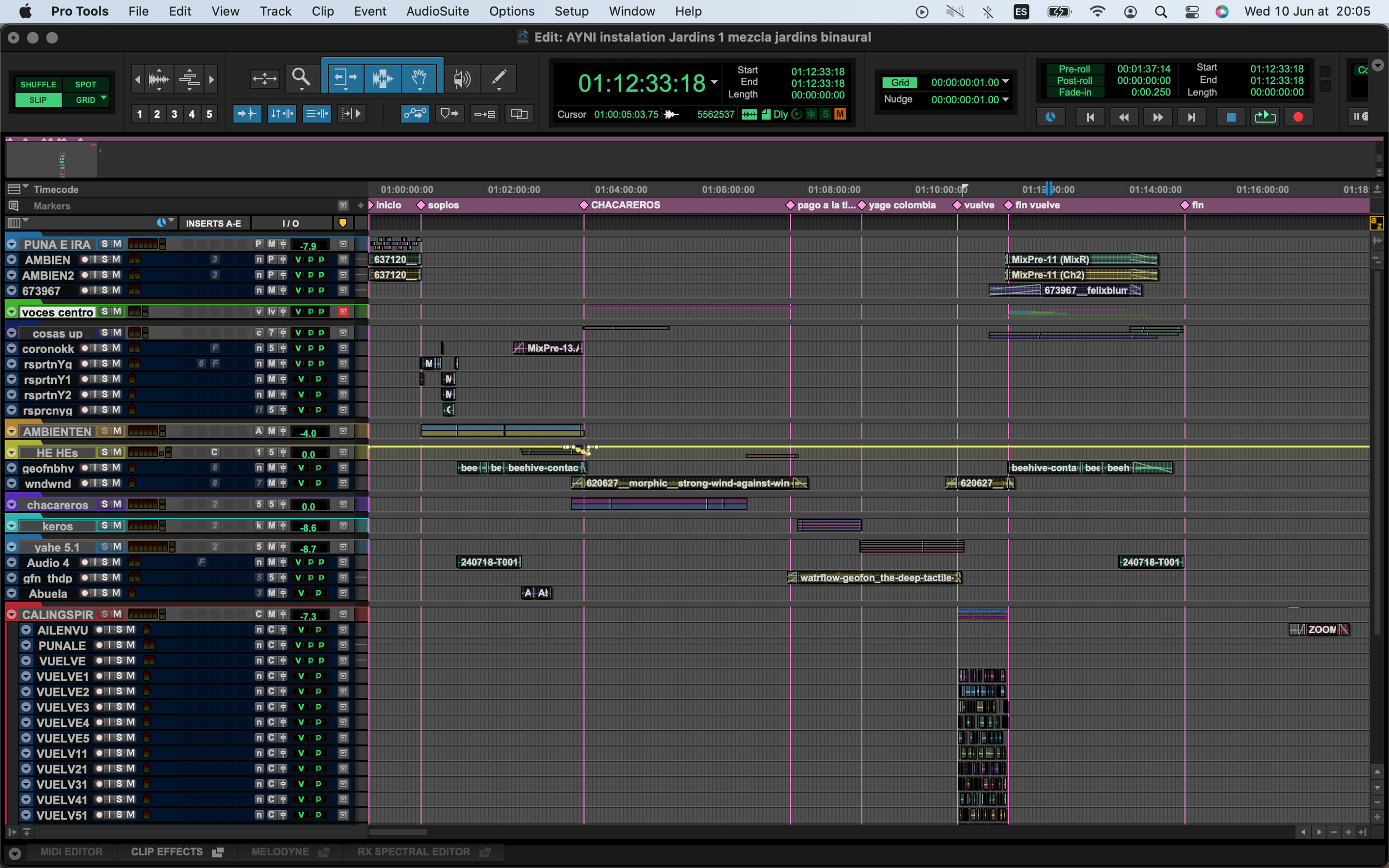
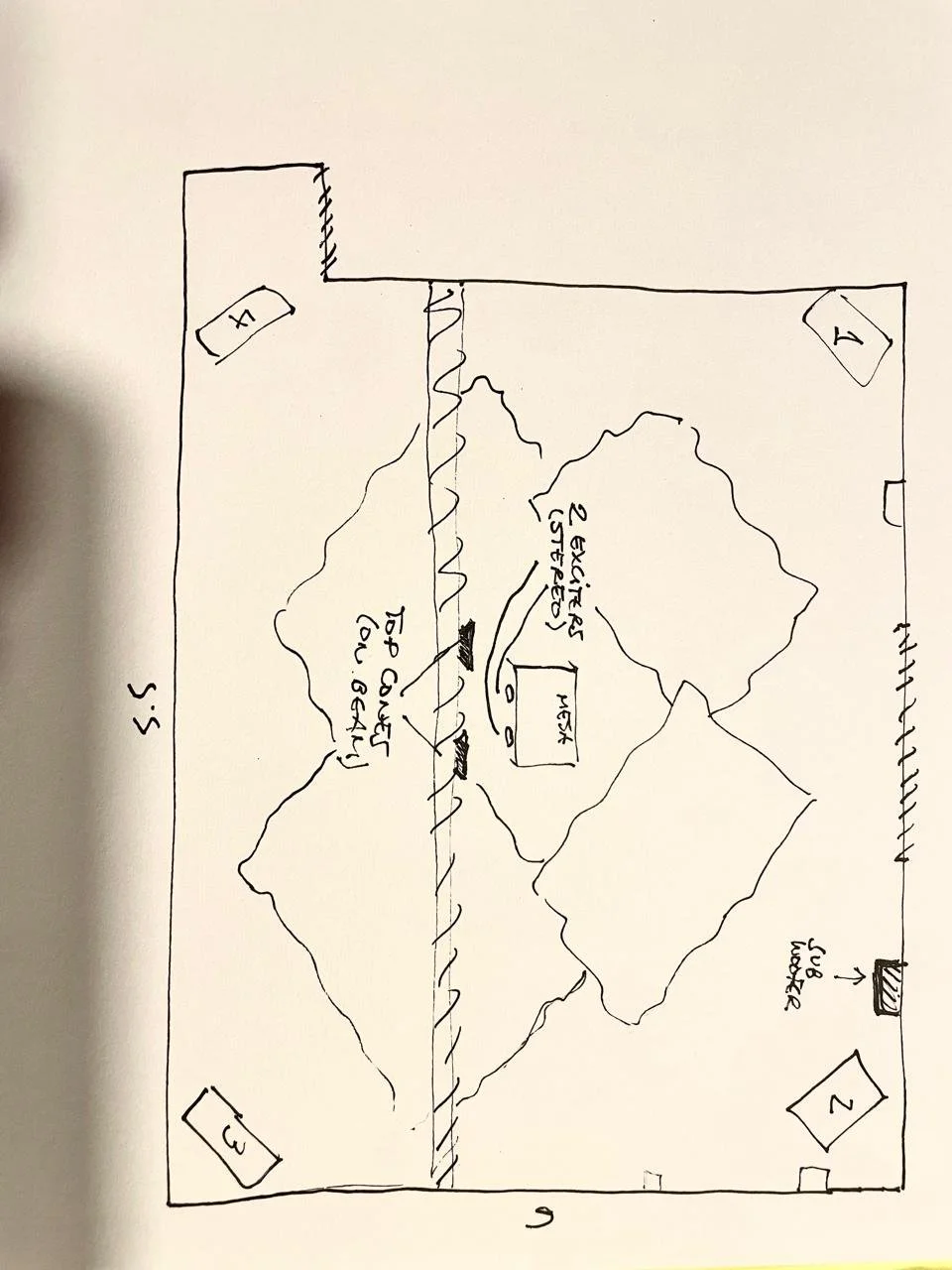
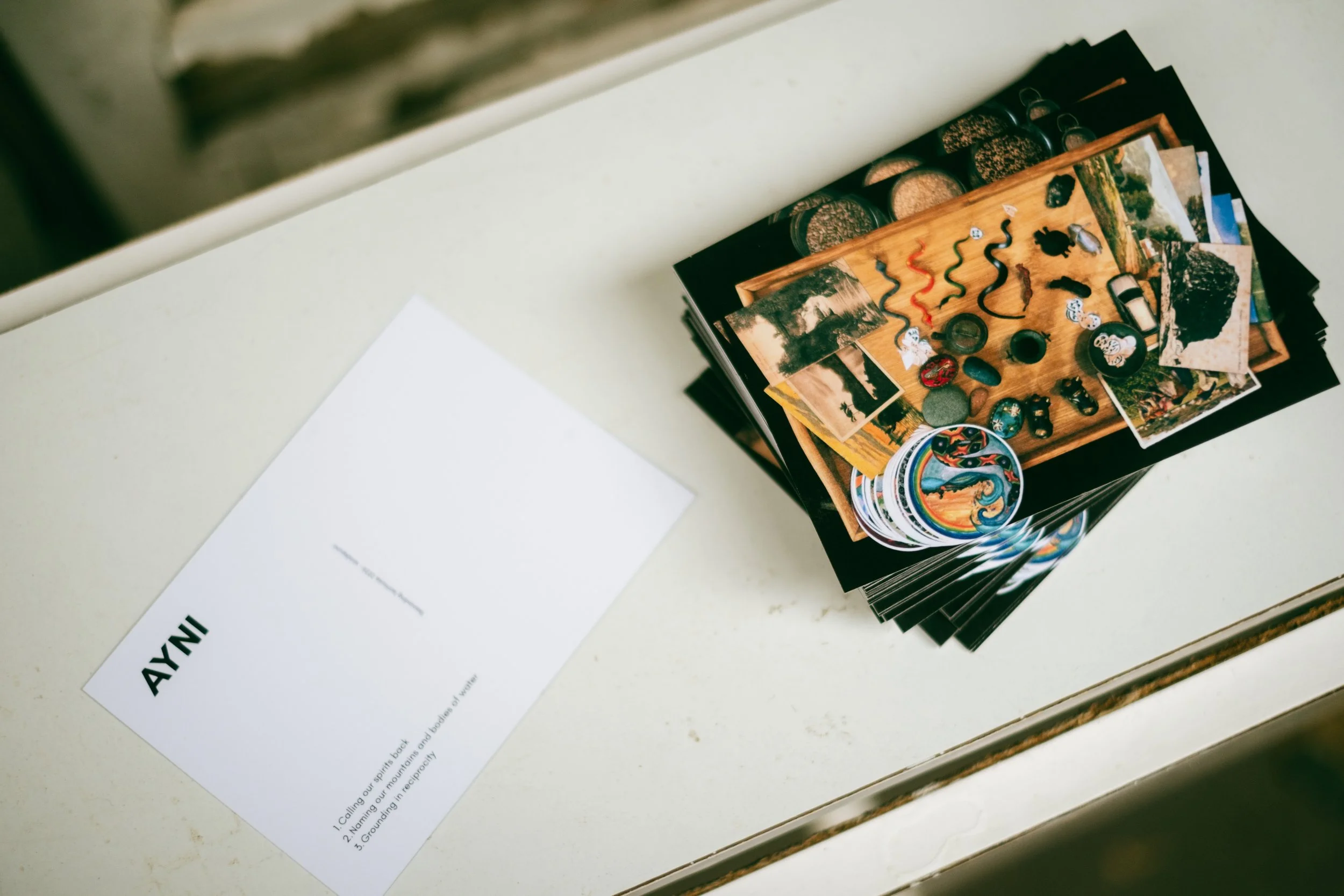
Photo postcard: Andreas Russo
Design and composition: Irazema H. Vera
Process documentation
Because the main purpose of the sound installation is to be able to be immersed in the sonic composition and highlight the omnipresence of territory and non-human elements so listeners can recognise them as a form of reciprocity and exchange, I decided to have a quadraphonic system (4 speakers as surround), two extra exciter transducers under the mesa (table), a subwoofer and two upper cones.
An idea present from the beginning was to have sound coming from the ground. Initially thought of as an outdoors installation, the transducers were gonna be placed in boxes slightly covered by soil. Due to practicality in terms of leaking from people and situations in the shared garden space, I started considering an interior space. Sala de Ensaio, the room I ended up choosing for it was ideal: dark and with elements to make it even darker, and not too big so it can be inviting for an intimate and collective listening experience. Once decided I started researching possibilities for adding exciters and other transducers.
As I work on most of my projects, an important part of this process is quite intuitive. Things start falling into place and either I adapt or use change as an opportunity for the project to find its own path. Transducers and cones were lent by Andre, a Brazilian colleague who also makes sound installations related to the Amazon forest and human and non-human relationships with it. Blankets were lent by two colleagues and elements in the mesa were gathered intuitively.
As in previous works, the postcard is an important part of the installation which serves both as informative and complementary as well as an offering. An initial composition of the mesa was made for the postcard photo, which then led to the final layout. Ruda plants were added both for their significance in the Andean cosmovision as well as its smell and texture as an extra sensorial element.
Finally, for the oral recitations, I initially requested colleagues to fill out a form with very simple questions about their places of belonging in order to open the process of acknowledging their territories beyond their urban places, as a way to make the recording process easier and more natural. Pepeha and llamados al ánima were recorded in Lisbon, Les Cevennes and Nantes in France, Dun Laoghaire in Ireland, and Lima and Puno in Peru. The purpose of combining them with the ritualistic sounds and traditions from communities with a strong relationship with the territory is to acknowledge Ayni. Even in urban environments and fast paced lives in Europe, the presence and existence of the territory and this concept of reciprocity can be acknowledged, also as a collective grounding experience. Following the days of the Resounding Territories event, I realised Ayni was created as a form of offering and as a very personal process of recognition in my sonic memory, elements that have grounded me and reminded me of the reciprocal relationship with the land and non-human elements around.
The sonic composition includes several immersive field recordings in the Amazon forest in Brazil and Peru, and in the southern Andes of Peru, as part of my field work with independent documentalists as a sound director. Many of them are of intimate ceremonies of reciprocity with the land, and musical expressions that celebrate the harvesting season. In addition, I included an interpretation of intimate and personal oral recitations that acknowledge people’s places of belonging while also highlighting the constant correspondence with the territory:
● the traditional Māori oral art of pepeha: to introduce ourselves acknowledging our ancestors and the mountains and bodies of water we are connected to
● the traditional Andean Llamado del ánima: Calling our spirit back. Susto in traditional Andean medicine in the Altiplano is interpreted as the escape of the spirit after a strong impression. The ritual of calling it back is a grounding practice to recover parts of ourselves lost to trauma, stress, or dissociation.
● An intimate whispered out loud communication with the spirits of natural phenomena and elements such as rain, thunder, wind, ocean, mountains as a way to acknowledge their power and ask for their protection. It also serves as a grounding recitation to self, to be reminded of having them as relatives, as guardians.
The sonic threads mentioned above are displayed together as a conglomerate multichannel soundscape composed of dialogues, testimonies, voices and field recordings, arranged in a specific “4.2.1.2” (quadraphonic - lower level, for people to lie down for listening - ; stereo central exciters - for pepeha, llamado del ánima and whispered recitation - ; subwoofer for ground low frequencies sound; stereo top cones for rain, birds and sounds coming from above) system specially designed for it.
These sonic interpellations throughout the process have been finally materialised and placed as part of the mesa, the central element of the installation, also portrayed in the postcard that serves as an additional offering. The items present in the mesa are a tribute to both acknowledge gratitude and nurture the earth; and ask her for protection, health and prosperity. Because traditionally it is prepared by a curandero/a2 as part of the ceremony led by him/her, I decided to interpret it as a personal approach to its composition that includes many symbolisms: sweets and seeds as abundance, ruda plants as protection, car and postcards of houses in the countryside as concrete wishes, Andean representative animals such as the snake, the puma and the two bulls, an Amazonian oracle, a family (a story drawn by my daughter), among others.
CONTEXTUAL
REFERENCES
Steven Feld’s Acoustemology and Ana Maria Ochoa’s Aurality are important starting points in how I have situated myself as a listener during my field work while being aware of the responsibility of recording it and writing about it. Brandon Labelle’s Listening Biennial introduced me to his Poetics of Listening and Acoustic Justice as potential listening practices in which the space in between that I am exploring can nicely sit and expand -without losing its elemental storytelling component-, while also acknowledging R. Murray Schafer’s acoustic ecology and Pauline Oliveros’s Deep Listening as foundational listening studies and practices.
Written:
Amelidis, P. (2015). Acousmatic Storytelling: A compositional approach (Doctoral dissertation, De Montfort University).
Attali, J. (1985). Noise: The political economy of music (B. Massumi, Trans.). University of Minnesota Press.
Bastani, H., & Soltani, N. (2023). Listening in/for Ekbatan: An Experimental Acoustemology. openwork, 1(1).
De la Cadena, M. (2015). Earth Beings: Ecologies of Practice across Andean Worlds. Durham: Duke University Press.
Doughty, K., Duffy, M., & Harada, T. (2016). Practices of emotional and affective geographies of sound.
Farina, A. (2018). Perspectives in ecoacoustics: A contribution to defining a discipline. Journal of ecoacoustics. Journal of Ecoacoustics.
Feld, S. (2015). [1] acoustemology. In D. Novak & M. Sakakeeny (Ed.), Keywords in Sound (pp. 12-21). New York, USA: Duke University Press.
Freychet, A., Reyna, A., & Solomos, M. (2021). Escuchando lugares. El field recording como práctica artística y activismo ecológico. In Escuchando lugares. El field recording como práctica artística y activismo ecológico (pp. 306-pages). Universidad Nacional del Litoral.
González, L. A. (2018). Más allá de la abyección aural. Hacia una escucha Híbrida de la diferencia. SONIDO, ESCUCHA y PODER, 11.
Labelle, B. (2025). Poetics of Listening: Inner Life, Social Transformation, Planetary Practices. Bloomsbury Academic.
Labelle, B. (2020). Acoustic Justice: Listening, Performativity, and the Work of Reorientation. Bloomsbury Academic.
LaBelle, B. (2012). Auditory relations. The sound studies reader, 468-74.
McGinnis, M. V. (Ed.). (1999). Bioregionalism (p. 1). London: Routledge.
Ochoa Gautier, A. M. (2014). Aurality: Listening and Knowledge in Nineteenth-Century Colombia. Duke University Press.
Oliveros, P. (2005). Deep listening: A composer's sound practice. iUniverse, Inc.
Sterne, J. (2012). The sound studies reader. Routledge.
Street, S. (2017). Sound poetics: Interaction and personal identity. Springer.
Tsing, A. L. (2015). The mushroom at the end of the world: On the possibility of life in capitalist ruins. Princeton University Press.
Westerkamp, H. (2002). Linking soundscape composition and acoustic ecology. Organised Sound, 7(1), 51–56.
The creative work of artists such as Félix Blume and Francisco López are an inspiration for AYNI and A corrente das vozes: the rhythmic and ‘musical motion’ of composing soundscapes with field recordings for the purpose of generating thresholds of abstraction (i.e. a listening experience oscillating in between the meaning and the actual sensorial experience itself) while honouring the beauty of the raw sounds. Going back to the importance of placing myself within my practice, I keep in mind the affective dimension of my liminal position in my recordings and process of composing soundscapes. For this reason, the work of Nigerian sound artist Emeka Ogboh is a crucial influence on migration and evoking rich personal and collective memories through multisensorial installations of home, honouring the sonic dynamism of home in European contexts.
Artistic: